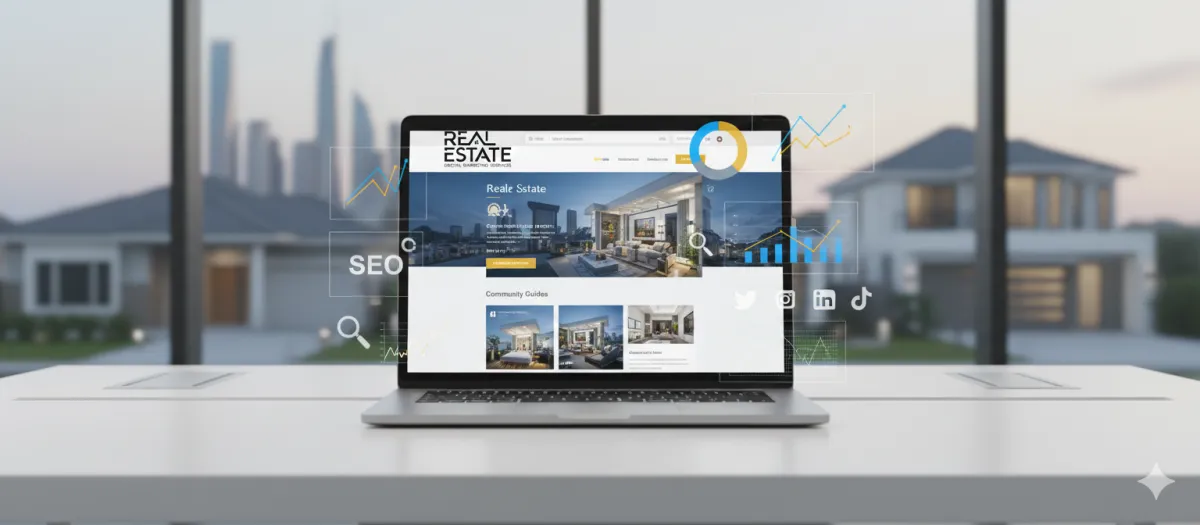
Four Real Estate Website Features Every Successful Agent Must Have in 2026
Introduction
The right real estate website features can determine whether your website becomes a powerful marketing engine — or just another online brochure. In 2026, a real estate website is no longer just a place to display listings; it is your most important digital asset and brand headquarters.
For today’s buyers and sellers, your website is often the first and most influential interaction they have with your business.
With AI-powered search, mobile-first browsing, and highly informed consumers, competition is fiercer than ever. If your real estate website features don’t immediately communicate value, trust, and expertise, visitors won’t hesitate to leave.
So what separates high-performing websites from the rest?
Below are four essential real estate website features every successful agent must implement in 2026.
1. Branded, High-Impact Listings (Not Generic IDX Pages)
One of the most important real estate website features in 2026 is branded listing presentation.
Today’s clients don’t visit your website to see the same listings they can find on Zillow or Redfin. They visit to experience:
Your marketing style
Your brand positioning
Your expertise
Modern real estate websites should include:
Branded property landing pages
Custom listing descriptions optimized for SEO
Professional photography, video, drone footage, and virtual tours
Clear calls-to-action (Book a Showing, Request Info, Download Brochure)
While IDX still plays a role, relying solely on generic MLS feeds weakens your brand and lowers conversion rates.
Digital marketing advantage:
Custom listing pages rank better in search results, perform stronger on social sharing, and convert significantly higher than generic IDX results.
2. Clear, Consistent Branding and Messaging
Another critical real estate website feature is immediate brand clarity.
Your website must instantly answer three questions:
Who do you help?
What do you specialize in?
Why should someone choose you?
In 2026, consistency across branding, visuals, and messaging is essential. Whether you serve luxury sellers, first-time buyers, relocations, or investors, your niche should be obvious within seconds.
Strong branding includes:
Cohesive colors, fonts, and design
Messaging aligned with your ideal client
Lifestyle-driven imagery
A clear, confident brand voice
Buyers and sellers hire brands they trust — not just agents.
Digital marketing advantage:
Consistent branding increases recognition, improves return traffic, and raises lead quality across ads, email, and organic search.
3. A Strategic, SEO-Driven Content Hub (Not Just a Blog)
High-performing real estate website features now include a structured content hub — not just occasional blog posts.
In 2026, your website must attract traffic from:
Google search
AI-driven discovery tools
Social media platforms
Email campaigns
Effective content includes:
Local market updates and forecasts
Buyer and seller guides
Community and lifestyle spotlights
Educational how-to articles
Short-form and long-form SEO-optimized posts
Fresh, relevant content signals authority to both users and search engines. An outdated blog damages credibility.
Digital marketing advantage:
Strategic content strengthens SEO, fuels social media, supports email marketing, and positions you as the trusted expert in your market.
4. Emotion-Driven, Experience-Focused Community Pages
Among the most powerful real estate website features today are experience-driven community pages.
Real estate is emotional. Buyers don’t just purchase homes — they choose lifestyles.
In 2026, community pages should go beyond basic data points. Instead of simply listing schools and commute times, they should include:
Story-driven lifestyle descriptions
Local culture and neighborhood highlights
Professional photos and short-form videos
Hyper-local market insights
Clear pathways to view listings or contact you
When visitors can imagine themselves living there, conversion rates increase dramatically.
Digital marketing advantage:
Emotion-focused community pages increase time on site, improve local SEO rankings, and significantly boost inquiry rates.
Final Thoughts: Your Website Is Your Digital Headquarters
The most successful agents understand that advanced real estate website features are not optional — they are strategic necessities.
In 2026, your website must be:
Brand-forward
Content-driven
SEO-optimized
Emotionally engaging
Built to convert traffic into real inquiries
If your current website isn’t actively generating leads, supporting your marketing campaigns, and positioning you as a local authority, it’s time to upgrade your real estate website features and align your platform with today’s digital standards.